
In the world of entrepreneurship, there’s a recurring mystery: why do some individuals with average grades and modest capital build empires, while ivy-league graduates with massive funding sometimes fail to keep a lemonade stand afloat? The answer isn’t just “luck” or “hard work.” It’s something much more visceral: Business Sense.
If you want to move beyond being a mere “operator” and become a true “architect” of commerce, you need to cultivate this instinct. Let’s break down what it is, where it comes from, and why it’s your most valuable asset.
1. What is “Sense” from normal to business context?
Before we talk about business, let’s talk about “Sense.” In a general context, a “sense” is an intuitive perception—a “feel” for how things work. It is a kind of feeling that arises whenever an unexpected event or a change in the environment occurs, reminding you of something you were previously unaware of. It can trigger a flash of nostalgia or present something entirely new that feels strangely familiar.
Within today’s topic, I only present 2 definitions that are closely related to “sense” as following:
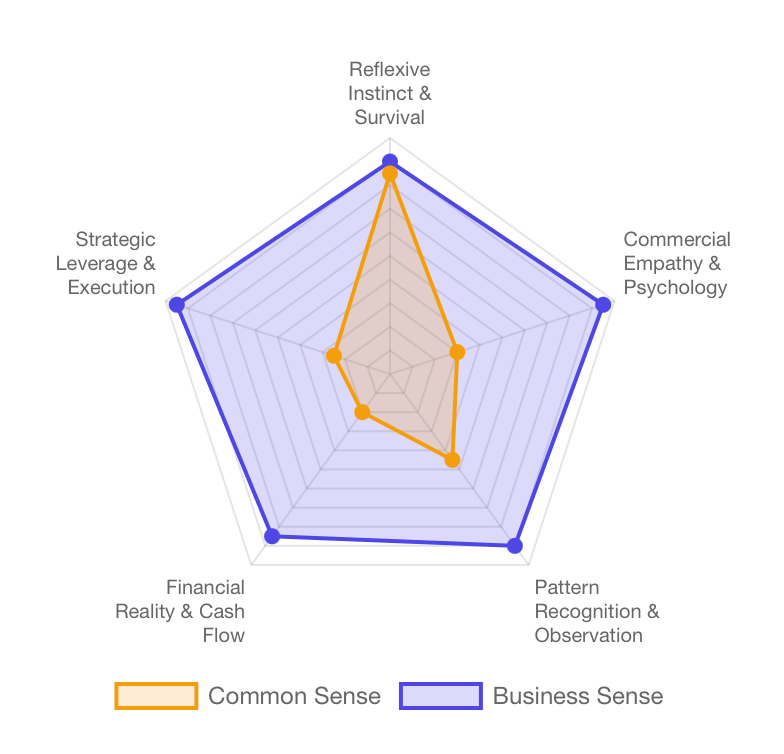
- Common Sense: This is the basic ability to perceive, understand, and judge things that are shared by nearly all people. It’s the voice in your head that says, “Don’t touch a hot stove” or “Don’t wear a tuxedo to a swimming pool.” In the legal world, we call this the “Reasonable Person Standard.” If a reasonable person wouldn’t do it, you probably shouldn’t either. More precisely, it is the instinctive feeling that emerges when you encounter a new situation or navigate a familiar one, requiring an immediate, active response to the people or objects around you. It is what we might call a “reflexive response.”
- Business Sense: This is Common Sense, but upgraded with a commercial engine. It is the ability to see a situation and instantly “smell” the profit or “feel” the coming and creation of wealth. Of course, business context is more complex than common sense in which more complicated situations involve different people with a variety of needs and desires. What comes from inside people and objects usually makes it difficult to recognize and define correctly the partners’ wishes under the influence of the environment.
- Therefore, if Common Sense tells you not to touch the hot stove, Business Sense tells you how to patent the stove, brand the heat, and sell the cooking experience to people who are afraid of fire.
2. What Lays under Business Sense?
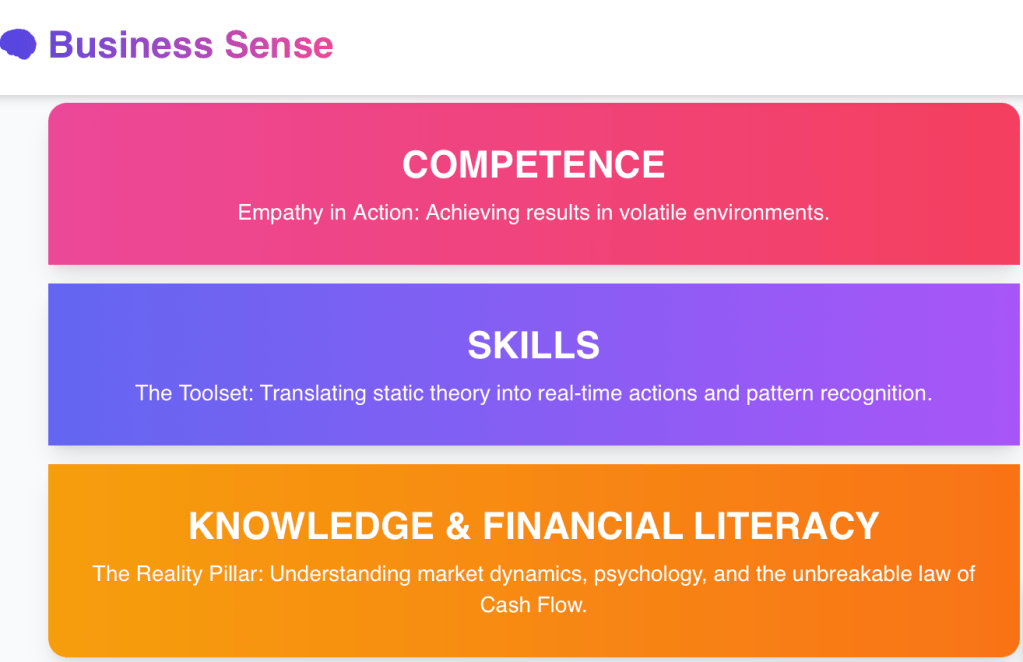
Business sense isn’t a mystical gift; it’s a multi-layered framework built on three levels of professional maturity:
- Knowledge (The Foundation): This is the theoretical bedrock—understanding market dynamics, finance, accounting, and human psychology. It is knowing what keeps your customer awake at 3:00 AM. Without this solid base of information, your intuition has no data to process, leaving you with “guesses” rather than “sense.”
- Skills (The Toolset): This is the bridge between theory and reality. It is the practical application of your observations—the ability to notice patterns, such as identifying why a coffee shop thrives despite mediocre products. Skills are the “know-how” that transform static knowledge into real-time actions, creating tangible value through consistent practice and active listening.
- Competence (The Master Pillar): This is the high-level integration of knowledge and skills to achieve results in volatile environments. It is “Empathy in Action”—the ability to shed your ego and inhabit the perspective of your market to secure a deal. Ultimately, competence is the signature quality that allows customers to distinguish your stand-out virtues from a sea of generic service providers.
- Financial Literacy (The Reality Pillar): You don’t need to be a CPA, but you must understand the “Law of Gravity” in business: Cash Flow. Business sense is knowing that a million dollars in “projected revenue” is useless if you can’t pay your electricity bill tomorrow.
3. Why You Need Business Sense to Succeed
In business, the “rules” are often written in grey ink. This is where Business Sense becomes your compass.
Navigating the “Legal” vs. “Logical” Gap
In business, just because something is legal doesn’t mean it’s smart. True business sense is a hyper-sensitive radar that allows you to recognize profitable opportunities that others scarcely figure out because they are buried beneath a bulk of chaotic and complicated factors. In high-pressure, dramatic situations, most people focus on self-defense or rigid compliance; the sense-driven leader finds the hidden leverage.
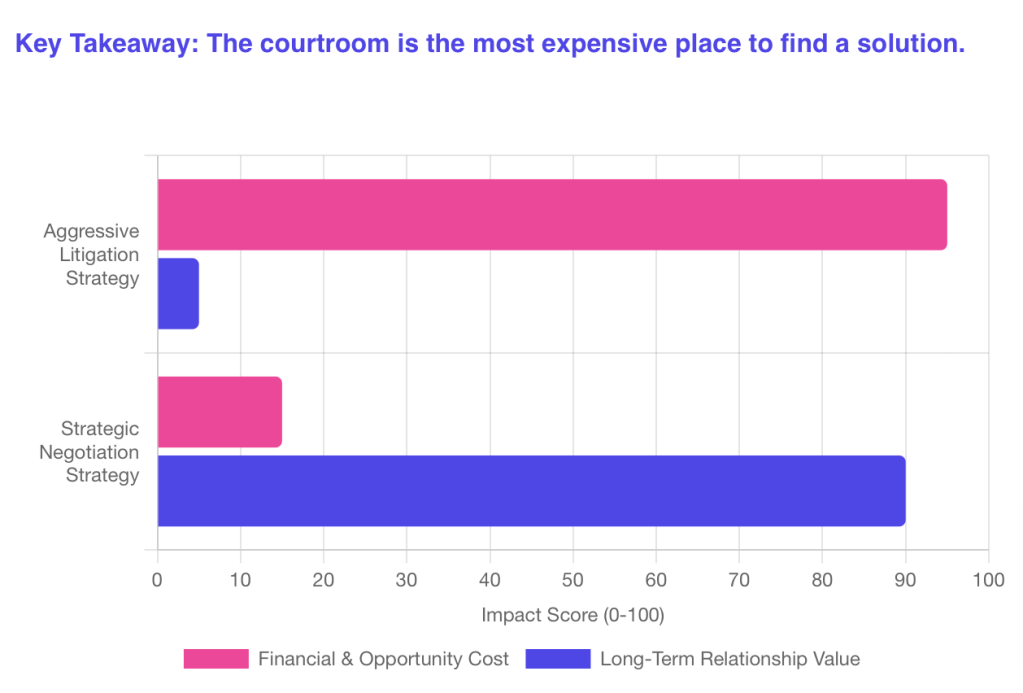
For example, you might have a watertight contract that allows you to sue a small supplier into oblivion for a minor delay:
- Without Business Sense: You sue them, win the case, and lose the supplier forever, halting your production for six months. You followed the letter of the law but failed the logic of the market.
- With Business Sense: You recognize that a “legal victory” is often “commercial suicide.” You filter through the chaos, negotiate a discount instead, keep the relationship, and keep the factory running. Business sense tells you that the courtroom is the most expensive place to find a solution.
Identifying “Non-Obvious” Risks
Success requires seeing the iceberg before the ship hits it. Business sense acts as a panoramic lens, allowing you to scrutinize a booming trend and extrapolate its true trajectory—separating sustainable growth from speculative bubbles—thereby ensuring you don’t plummet into the “big holes” that swallow those blinded by hype.
4. Business Sense in Commercial Transactions
Business sense isn’t just for the boardroom; it’s for every interaction where value is exchanged.
- The IP Asset Flip: Most people see a “cease and desist” letter as a dead end. Someone with business sense sees a potential partnership. If a competitor is infringing on your trademark in a market you haven’t reached yet, instead of just litigating, you could propose a licensing deal. You turn a legal headache into a passive revenue stream while letting them handle the local logistics.
- The White-Label Opportunity: Imagine you are a boutique manufacturer. A giant retailer wants to buy your product but demands a price so low you barely break even.
- Standard logic: Reject the deal.
- Business Sense: Accept it under the condition that they provide the raw data on customer demographics. You use their massive reach as a “paid focus group” to refine your own premium brand, which you sell elsewhere for 5x the profit.
- The Acquisition “Vibe Check”: Have you ever walked into a meeting and felt that the deal was “too good to be true”? That’s your business sense detecting a lack of “Substance over Form”—a classic legal and accounting principle. If the seller’s paperwork looks like a masterpiece but they are overly eager to close before your “Due Diligence” period is up, your business sense should be screaming for the exit. It’s the ability to sense when you’re not buying a business, but rather buying someone else’s lawsuit.

Conclusion
Building Business Sense is a journey of turning “oversight” into “insight.” It requires you to be curious, to fail small so you can learn big, and to always look for the “why” behind the “what.”
Remember, in the eyes of the law, ignorance is no excuse. In the eyes of the market, a lack of business sense is even more unforgiving. Develop your instinct, sharpen your empathy, and always keep one eye on the spreadsheet and the other on the human heart. That is the only true “secret” to lasting success.
Lawyer Nguyễn Việt Thùy Trang

